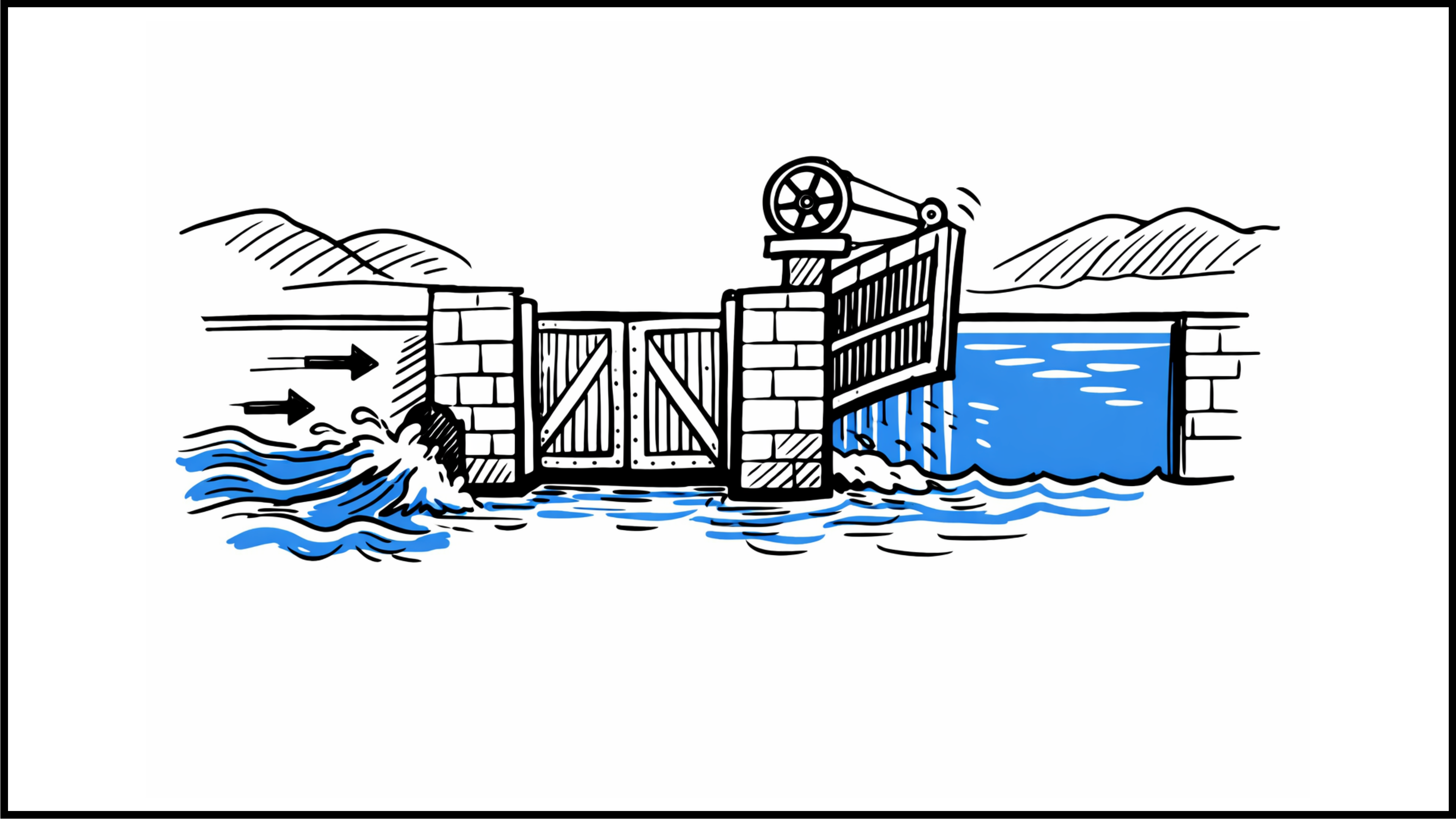
The Lockkeeper of Riverton
Working With Water, Not Against It

The river ran through Riverton like a contract no one had signed but everyone still obeyed.
It didn’t care about intentions.
It didn’t care that the men and women on the south end of town could calculate pressure differentials and design steel to survive a thousand winters. It didn’t care that they kept pumps running, lines safe, valves quiet, and energy moving.
The river only cared about one thing:
flow.
And the truth was brutal in its simplicity:
Work flowed downhill every day.
Cash did not.
At Hearthline Engineering, they called it “timing.”
They said it the way people say “weather,” as if naming it made it less dangerous.
They were busy. They were booked. They were respected.
And they were, somehow, always short of breath.
The Lockkeeper
Dana was the one who heard the river closest.
Not out at the well sites.
Not in the project kickoffs.
Not in the boardroom where confidence was considered a duty.
Dana heard it in the billing cycle.
She heard it in the thinness of vendor emails that got “more formal” the longer they went unanswered.
She heard it in payroll week, when a company that built things for a living began to feel like it was surviving on prayer.
The truth wasn’t that invoices were hard.
The truth was that the facts required to build an invoice lived in too many places.
Hours in one system. Rates in another. Exceptions in a manager’s head. Approvals in email threads that started clean and ended like tangled rope.
The process to invoice clients took several days almost a week—every cycle—because the river had become a maze.
It wasn’t just slow.
It was leaky.
And every leak stole pressure.
Dana didn’t say “pressure,” of course.
She said what people in real offices say:
“I’m drowning.”
She was good at her job. She had grit. She had lists. She had patience.
But grit is not a strategy.
And patience is not a lock.
One Thursday—always a Thursday—an invoice went out wrong.
Not wildly wrong. Not scandalously wrong.
Just wrong enough that the client did what clients do when the details feel suspicious:
They paused.
They questioned.
They waited.
And waiting, Dana had learned, was the most expensive thing a client could do.
That same week, the company president—Ross—walked into Dana’s office with that careful calm leaders use when they’re trying not to spread panic.
“How bad is it?” he asked.
Dana didn’t look up at first. She was staring at her screen like it might confess.
Then she said the sentence that changed the air in the room.
“We’re not short on work. We’re short on getting paid.”
Ross stared at the river.
And finally admitted he didn’t know how to control it.
The River Doesn’t Negotiate
Riverton had a saying: Water wins.
Not because it’s violent.
Because it’s persistent.
It will always find its way. Under. Around. Through.
The company had been trying to fight it—trying to push cash flow uphill with reminders and urgency and heroic late nights.
That works for a while.
Then the river teaches you the real lesson:
You don’t beat water. You design for it.
Ross did what overwhelmed leaders do when they realize the problem is structural.
He looked for help.
Not a loan.
Not a new accountant.
Not a motivational speech.
A builder.
Someone who could look at a messy system and see a clean one hidden inside it.
Someone who worked with water.
Not against it.
A peer—an old friend who’d survived his own near-drowning—sent Ross a short note:
“There’s a guy. He doesn’t sell software. He builds locks.”
No logo. No brochure.
Just a name.
Mark.
They called him The Builder.
The Builder’s First Question
When The Builder arrived, he didn’t walk in like a savior.
He walked in like a man who has seen this river before.
He listened to Dana for a long time.
Not the polite listening of sales calls.
Real listening—the kind that makes you feel your own problem becoming clearer because someone else is holding it steady.
Then he asked one question.
Not “What software do you use?”
Not “How many invoices per month?”
Not “What’s your budget?”
He asked:
“Where does billing truth live?”
Dana blinked.
She started to answer—and then stopped—because she realized the answer was: nowhere.
Or more accurately: everywhere.
And “everywhere” is the same as nowhere when you’re trying to build something reliable.
The Builder nodded like he’d been expecting that.
Then he stood up, walked to the whiteboard, and drew a river.
He drew tributaries feeding in from different directions.
Hours.
Rates.
Expenses.
Change orders.
Approvals.
He drew little breaks where the tributaries went underground.
He drew side channels where work got recorded twice.
He drew whirlpools where emails spun in circles.
Dana watched him draw what she’d been living.
Then he drew a simple rectangle across the river.
A lock.
And he said, “We’re not going to fight the river.”
He tapped the rectangle.
“We’re going to give it a channel.”
The Rock
He didn’t bring a new river.
He brought stone.
He brought Method CRM—not as “a CRM,” not as “a tool,” but as the place the lock would be built.
“The rock,” he called it.
“The body of the lock.”
Dana didn’t fully understand yet, but she understood something more important:
For the first time, someone wasn’t asking her to bail faster.
Someone was talking about building.
The Builder explained it in plain language:
“All the water you need is already here—your work, your hours, your rates, your projects. The problem is the water isn’t gathering. It’s leaking out into side channels. And the gates aren’t real gates. They’re emails.”
He pointed at Dana’s inbox.
“That’s not a gate. That’s a swamp.”
Dana laughed once—sharp and tired—because it was true.
Then he said the sentence that felt like a promise:
“We’re going to make it so billing isn’t a week-long event. It’s a controlled release.”
The Gatework
They didn’t start with the button.
That was the mistake people always wanted to make—jump to the miracle.
The Builder started with the stones.
He asked Dana what fields mattered.
What details the client needed.
What caused disputes.
What managers insisted on approving.
What exceptions always showed up late in the game like someone crashing a meeting.
Then they built the first gate:
A single place where billable work could be assembled before it became an invoice.
Not in five systems.
Not in Dana’s head.
In one visible channel.
The company resisted at first.
Not because they loved chaos.
Because people get attached to the little workarounds that make them feel essential.
A project manager said, “But I’ve always tracked this in my spreadsheet.”
A supervisor said, “I need to approve this before it goes out.”
An engineer said, “Billing isn’t my job.”
The Builder didn’t argue.
He simply mapped the river again and asked,
“How’s that working out?”
One by one, they agreed to move their little tributaries into the lock.
Not because they suddenly loved the process.
Because they were tired of drowning.
They built approvals as real gates—clear, visible, tracked.
They built rules so exceptions weren’t surprises; they were designed openings.
They built reports so leadership didn’t have to ask Dana how deep the water was.
They could see it.
And as they worked, Dana noticed something strange:
The more structure they added, the less work she had.
Not less responsibility.
Less chaos.
Less scavenger hunting.
Less rework.
Less apologizing for numbers she didn’t trust.
It wasn’t magic.
It was physics.
The Storm
Halfway through the build, a storm hit.
A major client delayed payment.
A vendor tightened terms.
Payroll week arrived like a black cloud with a calendar.
Ross walked into Dana’s office again, and this time he didn’t ask how bad it was.
He asked, “Are we going to make it?”
Dana looked at the river and felt the old temptation rise:
Forget the lock.
Grab buckets.
Work late.
Push harder.
The Builder heard the panic in the building the way you can hear wind before a storm breaks.
He didn’t scold.
He just said, quietly:
“Buckets make you feel busy.”
He tapped the lock on the board.
“Locks make you safe.”
Then he looked at Dana.
“Are we close enough to release?”
Dana swallowed.
“Close,” she said. “But not perfect.”
The Builder nodded.
“Water doesn’t wait for perfection.”
He turned to Ross.
“If you want control, we release what we can control.”
And they did.
The First Controlled Release
On Monday morning, Dana pressed the button for the first time.
Not a metaphorical button.
A real one.
The kind you don’t trust until you’ve watched it work.
She pressed it, and the system did what systems do when they’ve been built properly:
It gathered the water.
It applied the rules.
It respected the gates.
It assembled invoices with detail that made sense.
No manual math.
No missing pieces.
No hunting down that one approval buried in a thread from last Thursday.
The invoices went out before lunch on Monday not Thursday.
Dana sat still, waiting for the familiar rebound—the follow-up panic, the correction, the client call.
Instead, something new happened.
Nothing.
No alarms.
No scrambling.
Just… flow.
Later that week, payments arrived faster—not because the clients became kinder, but because the invoices were clearer.
Water doesn’t like confusion.
Neither do customers.
Dana pulled up a report and saw, for the first time, the business as a reservoir instead of a guessing game:
Hours by employee.
Bill rates.
Pay rates.
What was approved.
What was pending.
What could be released today.
Ross looked at the report like a man seeing a coastline after weeks at sea.
“This,” he said, “is what I’ve been missing.”
The Builder corrected him gently.
“No,” he said. “This is what you’ve been living without.”
Dana’s Change
Dana didn’t become a different person.
She became the same person, with the river finally behaving.
Her shoulders dropped.
Her mornings stopped starting with dread.
She began to do what competent people do when they’re no longer trapped in triage:
She started thinking about the next constraint.
Time tracking.
Payroll.
Reporting.
The world of possibilities that opens up when one impossible thing becomes easy.
She walked into Ross’s office one afternoon and said,
“We can fix more than invoicing.”
Ross smiled—a small, tired smile, the kind that means relief is real.
“I know,” he said. “But I want you to take a breath first.”
Dana laughed.
“I am,” she said. “That’s the point.”
Moral of the Story
The river will always have its way.
Work will always flow.
But if you don’t build a channel—if you don’t decide where the truth lives—your work will still move… just not into your hands.
You don’t fight water.
You build a lock.
You place rock.
You set gates.
And you learn to release cash the way nature intended:
with control, not heroics.
If your invoicing feels like bailing water with a bucket—if cash flow problems aren’t about sales but about timing and truth—then you don’t need more effort.
You need a lock and we are The Builder, The Builder of invisible things. We work value-for-value: real outcomes, fairly paid.